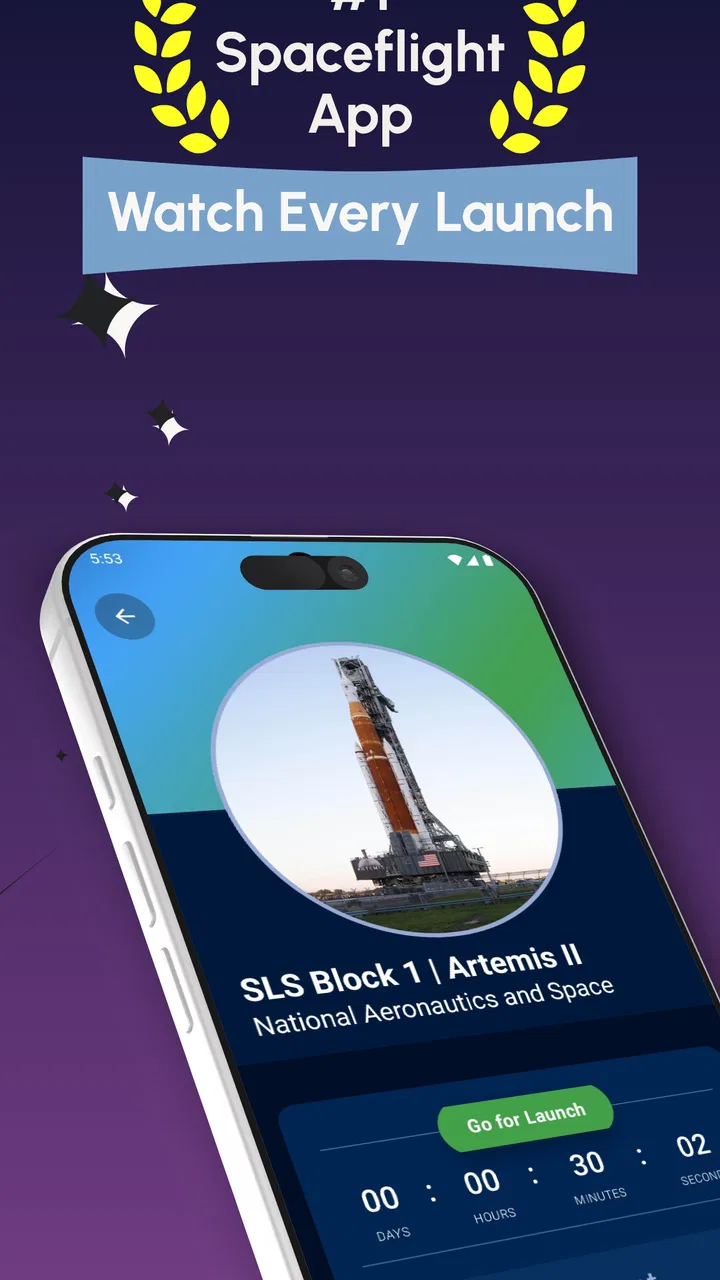
Space Launch Now - Tracker
- 4.8
- Rating
- 100.00K
- Installs
- Free
- Price

 Analysis by App-foxy
Space Launch Now - Tracker is the kind of news app I open when a rocket launch is no longer an abstract headline but an event I actually want to follow. Its central promise is simple: it brings launch schedules, countdowns, and alerts for missions connected with SpaceX, NASA, ISRO, and ESA into one place. That focus makes it much more useful than a general news feed when I want to know what is happening next in spaceflight.
What I like most is that the app treats a launch as something to follow over time, not just a story to read after the fact. A countdown gives me a reason to check back, while alerts can help me avoid missing a window that may happen at an inconvenient hour. For anyone who regularly watches launches, that change from passive reading to active tracking is the feature that matters most.
Why the countdown-and-alert approach works
Most news and magazine apps are designed around articles. I read a headline, scroll through related stories, and move on. That works well for learning what has already happened, but it is less helpful when I am waiting for a launch. Space Launch Now - Tracker is built around the opposite question: which mission should I be watching, and when does it become important?
You May Also Like

 Blood Strike: 2.5 Anniversary
Blood Strike’s Loadouts Turn Every Drop Into a Tactical Gamble
A close look at Blood Strike’s custom loadouts: how fast access to signature weapons reshapes its battle royale rhythm, rewards preparation, and narrows the gap between fights.

 Pandora - Music & Podcasts
Pandora’s Music Is Easy to Start, but Harder to Recover
Pandora’s strength is its low-effort path from a seed to a station. Its weak spot is how much confidence it asks you to place in connection, setup, and quiet recovery.

 8 Ball Pool
 Is Built on Rivalries, Rematches, and Routine
A close look at the rivalries, rematches, shared routines, and unanswered safety questions that turn a quick pool match into a persistent mobile community.

 Samsung Music
’s Quiet Strength Is Playing What You Already Own
Its reach comes less from spectacle than from dependable access to a personal library. That simplicity is both the app’s strongest retention engine and its ceiling.

 AccuWeather: Weather Radar
AccuWeather Review: A Quick, Clear Forecast for Everyday Decisions
For everyday plans, the best forecast is the one you can understand quickly. AccuWeather makes rain timing, radar, and local conditions easy to act on, with a few trade-offs.

 Hill Climb Racing
Why Hill Climb Racing Still Turns Crashes Into One More Run
A tiny car, a bumpy hill and one more upgrade: Hill Climb Racing keeps resurfacing because its simple chaos makes every near-miss feel personal.
More From Our News Desk



The app comes from developer Caleb Jones and sits in the news and magazines category, although I would describe its practical role as a specialized spaceflight calendar with live-event awareness. It is free to install, which makes it easy to try without committing money first. The content rating is Everyone, so it is also approachable for families, students, and younger space enthusiasts who want a straightforward way to follow missions.
The most valuable capability is the combination of a launch countdown with timely alerts. A schedule alone is easy to forget. An alert alone can become noise. Together, they create a small routine: I can look ahead, decide which missions matter to me, and let the app remind me when the event is getting close. That is a much better fit for launches than relying on a general-purpose calendar or hoping a social feed happens to surface the right post.
There is also a useful difference between following a launch and merely searching for it. Searching usually begins after I remember the mission name or hear a rumor about a date. A dedicated tracker gives the event a place in my regular information flow. That is especially helpful for missions from agencies or launch providers I do not check every day, including ISRO and ESA alongside NASA and SpaceX.
What I actually get from a focused space news app
In everyday use, I see the app as a filter. Spaceflight news can be scattered across agency pages, launch-provider announcements, specialist websites, video channels, and social networks. Each source has value, but checking all of them is tiring. A focused tracker reduces the number of places I need to monitor when my main concern is timing.
That does not mean it replaces detailed reporting. If I want a deep explanation of a spacecraft, a technical breakdown of a launch vehicle, or a long investigation into a mission, a dedicated space publication is usually better. Space Launch Now - Tracker is strongest at answering the practical question, “When should I pay attention?” It is a companion to deeper sources rather than a complete substitute for them.
The app’s established audience also gives me confidence that it is not an abandoned experiment. It has an average rating of 4.8 from around fourteen thousand ratings, with roughly two and a half thousand written reviews, and it has passed one hundred thousand installs. Those figures suggest that the focused format resonates with a substantial group of people, while the written feedback volume indicates that users have spent enough time with it to form opinions beyond a first glance.
How I use the countdown in practice
My preferred workflow starts with a quick check of the upcoming launch list rather than opening the app only when I see a headline. I look for missions that fit my schedule, then decide which ones deserve an alert. This is a small habit, but it prevents the common problem of discovering a launch after the live moment has passed.
The countdown is most useful when I treat it as a planning tool instead of a promise that the event will happen at exactly that moment. Launch schedules can move, and a countdown cannot remove the uncertainty built into spaceflight. I use it to organize my attention, then stay flexible if the timing changes. That mindset avoids disappointment and makes the alerts feel informative rather than frustrating.
A practical tip is to check the app earlier in the day when a launch interests me. If the event is scheduled during work, school, or sleep, I can decide in advance whether it is worth setting aside time. This is more efficient than waiting for a last-minute notification and then trying to understand the mission while rushing out the door.
Another useful habit is to use the app as a starting point before opening a livestream or a detailed article. The tracker tells me which event is approaching; a video channel or specialist report can then provide the background. This two-step workflow works better than using a general news feed for everything because it separates timing from explanation.
Alerts are helpful, but I would not turn on every possible notification without thinking. A person who follows every agency and provider may receive reminders for events that are interesting in theory but irrelevant on a busy day. I get more value when I treat notifications as a personal shortlist. The app is better when it supports my attention instead of competing for it.
A realistic launch-day routine
Imagine I am at work on a weekday and know that a mission I care about is scheduled later. I can check the tracker in the morning, note the countdown, and decide whether I want to watch live or simply follow the outcome afterward. If I choose to watch, an alert gives me a practical reminder without requiring me to keep refreshing a webpage throughout the day.
Shortly before the event, I would use the app to confirm that the launch is still the item I am waiting for, then move to a livestream or a more detailed source for the actual coverage. If the schedule changes, the tracker remains useful because it tells me that my original plan needs adjusting. The value is not only the final notification; it is the way the countdown helps me make a decision before the event becomes urgent.
For a student, the same workflow can support a small learning project. A launch can become a fixed point for researching the mission, the destination, and the agencies involved. The tracker supplies the time-based structure, while other sources supply the science. I would still verify technical details elsewhere, but the app makes it easier to choose a mission and follow it consistently.
Where the app fits beside ordinary alternatives
A general calendar can remind me about an event, but it usually requires manual entry and does not feel connected to a changing launch schedule. A general news app may report a launch, but it often prioritizes popularity and breaking stories rather than maintaining a clean view of what is coming next. Social media can be fast, but it can also bury important updates under unrelated posts.
Space Launch Now - Tracker occupies a more useful middle ground. It is more organized than a social feed and more purpose-built than a personal calendar. Its advantage is not that it provides every possible piece of space coverage; its advantage is that it keeps launch timing visible without making me assemble the system myself.
Compared with a specialist space-news website, the trade-off is depth. A website may offer richer articles, interviews, mission analysis, and extensive background. I would choose that kind of source when I want to understand why a mission matters. I would choose this app when I want a dependable way to remember that the mission is happening and when to look for coverage.
That distinction also explains why I would not recommend it as the only space app for everyone. If your interest is mostly astronomy news, telescope discoveries, or long-form science writing, a broader publication may give you more value. If your interest is specifically launch timing and live awareness, the focused design is much more convincing.
The trade-offs I noticed during regular use
The narrow focus is both the app’s strength and its main limitation. I appreciate not having to wade through unrelated technology news, but I also know that the app will not satisfy someone who wants a full daily space magazine. Its purpose is concentrated, so the experience feels less rewarding when I am in the mood to browse widely.
Countdowns can also create an expectation of certainty that spaceflight does not always allow. Weather, technical checks, range conditions, and operational decisions can affect launch timing. I would never treat the displayed schedule as a guarantee. The app helps me prepare, but I still expect plans to change and would check current coverage when the launch becomes important.
Notifications require some personal management. They are valuable for a launch I genuinely want to watch, but constant alerts can turn a helpful tracker into background noise. I recommend beginning with the least distracting setup and increasing notifications only if you find yourself missing events. The best configuration depends on whether you follow a few major missions or nearly everything on the calendar.
There is also a difference between being alerted and being fully informed. A reminder can tell me that a launch is approaching, but I may still need another source for a livestream, mission explanation, or detailed status update. That is not a flaw in a countdown-focused tool, but it is important to understand before expecting it to replace every other service.
The app is free, which lowers the barrier to entry, but it includes optional in-app purchases ranging from $0.99 to $49.99 per item. I would approach those purchases carefully and first decide whether the free experience already covers my needs. The broad price range means users should pay attention before confirming anything, particularly if they are handing the device to a child or using a shared account.
Because the app has been available since April 20, 2016, I see it as a mature project rather than a newly launched novelty. That long presence is reassuring for a tracker whose usefulness depends on returning to it over time. Still, maturity does not eliminate the need for sensible expectations: launch information is inherently changeable, and no app can make a moving schedule perfectly stable.
Small habits that make it more useful
- Use alerts selectively: choose the missions you would genuinely watch instead of enabling every reminder immediately.
- Check before planning around a launch: use the countdown to organize your day, but confirm the latest status through current coverage when the event matters.
- Pair timing with depth: let the tracker identify the event, then use a specialist article or livestream when you want technical context.
- Review upcoming missions regularly: a short check can reveal launches from agencies you might otherwise overlook, especially if your attention normally stays on one provider.
These habits highlight an important trade-off: the app saves me time only when I use it as a focused organizer. If I expect it to answer every question about every mission, I will probably find the experience incomplete. If I use it to control when and where I direct my attention, its limited scope becomes an advantage.
Who will get the most from it
I would recommend Space Launch Now - Tracker to a launch enthusiast who follows multiple organizations and is tired of piecing schedules together manually. It is also a good match for someone who watches launches occasionally but often misses them because the dates are easy to forget. The countdown and alert combination gives both groups a practical reason to return.
It can work well for families too, especially when a parent wants a simple way to plan a shared viewing session. The Everyone rating makes the app approachable, and the launch-centered format is easier to explain to a child than a busy stream of general news. I would still manage purchase settings and notifications myself rather than leaving every choice to a young user.
Students, educators, and amateur space communicators may also find it useful as a scheduling layer. It can help select a mission for a classroom discussion, a club meeting, or a personal research project. The important point is to use it for dates and reminders while relying on appropriate educational or official sources for scientific accuracy and mission detail.
I would skip it if your main interest is broad science journalism, astronomy images, spacecraft engineering analysis, or a continuous livestream experience. In those cases, a general science publication, specialist space website, or video platform may be a better primary tool. I would also skip it if you dislike notifications and have no interest in checking launch schedules; the app’s central benefit will not matter much then.
For me, the strongest reason to keep it installed is not that it replaces my other space resources. It does something narrower and more useful: it gives upcoming launches a visible place in my routine. That makes it easier to decide what deserves my time, whether I want to watch live, and when I should look for deeper coverage.
After using it as a launch-planning companion, my opinion is positive but specific. This is a focused countdown tool, not a complete space-news universe. Its free entry point, broad agency coverage, and alert-driven approach make it a sensible choice for people who care about launch timing. The limitations are manageable as long as I remember that schedules can shift and detailed reporting may require another source.
With an average rating of 4.8 and more than one hundred thousand installs, it has clearly found a loyal audience. I understand why: the app solves a small but recurring problem without asking me to build my own tracking system. If you want to follow launches more reliably, especially across SpaceX, NASA, ISRO, and ESA, I think it is worth trying. If you want a broad magazine or deep mission analysis, I would use it alongside something else rather than expecting it to do everything.
FAQs for Space Launch Now - Tracker
01What is Space Launch Now - Tracker?
Space Launch Now - Tracker is a mobile application designed to help users follow upcoming and completed space missions in one place. It provides launch schedules, mission details, countdowns, rocket and spacecraft information, provider details, and notifications. The app is useful for space enthusiasts who want a convenient way to monitor launches from agencies and companies around the world.
02Which space launches can I follow with the app?
The app covers a broad selection of orbital launches and spaceflight events, including missions from major agencies and private launch providers. Depending on the available data, you can view information about rockets, payloads, launch sites, mission objectives, and participating organizations. Launch coverage and details may vary, so checking the app regularly is recommended when following a specific mission.
03Does Space Launch Now provide launch reminders and notifications?
Yes, one of the app’s most practical features is its notification system for upcoming launches. Users can generally receive reminders about scheduled events and stay informed when launch times change. This is especially helpful because spaceflight schedules can move due to weather, technical checks, or range restrictions. Notification options may be adjustable in the app’s settings.
04Is Space Launch Now - Tracker free to download and use?
Space Launch Now - Tracker can be downloaded for mobile devices, but the exact pricing model may depend on the platform and the version available in your region. Core launch-tracking features are typically accessible without a complicated setup, while some versions may include advertising or optional paid features. Review the store listing before downloading to confirm current costs and in-app purchase details.
05Does the app show live launches or only launch schedules?
The application is primarily a launch-tracking and information tool, offering schedules, countdowns, mission descriptions, and updates rather than replacing a dedicated live-streaming service. Some mission pages may include links or references to coverage when available, but live video availability depends on the launch provider and event. For real-time viewing, users may need to open an external broadcast source.
Pros
- Tracks upcoming launches from NASA
- SpaceX
- ESA
- and other providers.
- Includes detailed mission pages with payload
- vehicle
- and launch-site information.
- Push notifications help users avoid missing scheduled launch windows.
- Calendar view makes it easy to browse launches by date.
- Clean interface is quick to navigate and suitable for space enthusiasts.
Cons
- Launch times can change frequently because schedules depend on weather and technical issues.
- Some mission details may be incomplete for lesser-known international launches.
- Advanced tracking features may feel excessive for casual users.
- Notifications can become frequent when following many missions at once.
- Certain information may depend on internet access and updated external data sources.

Space Launch Now - Tracker
Gallery